







Head Office
141-A, Electronic complex, Pardesipura,Indore - 452010 India
Phone: +91 73899 00887 , +91 98932 70303
Email:info@nvistech.com
Toll Free
+91 73899 00887
Working Hours
We are happy to meet you during our working hours. Please make an appointment.
- Monday-Saturday: 9:00 AM - 5:30 PM (IST)
- Sunday: Closed
Head Office
141-A, Electronic complex, Pardesipura,Indore - 452010 India
Phone: +91 73899 00887 , +91 98932 70303
Email:info@nvistech.com
Toll Free
+91 73899 00887
We are happy to meet you during our working hours. Please make an appointment.
- Monday-Saturday: 9:00 AM - 5:30 PM (IST)
- Sunday: Closed
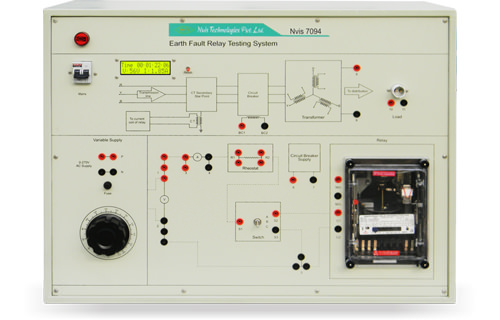
Earth Fault Relay Testing System
Nvis 7094
Product Description
The Nvis 7094 Earth Fault Relay Testing System is designed to provide practical exposure to protection devices used to prevent faults in electrical circuits caused by earth leakage current. This system is widely used for earth fault relay testing and for understanding protection mechanisms in electrical power systems.
Protection of electrical systems is essential to ensure safe and reliable operation. Various protective devices are used in power systems, and understanding their functionality helps prevent system failures and equipment damage.
Earth leakage current can lead to heat generation and gradual insulation failure, eventually causing earth faults and sparking. The earth fault relay detects leakage current before it exceeds the threshold limit, ensuring timely protection.
The Nvis 7094 offers a complete learning platform for studying the connection of earth fault relays in transmission lines and performing testing procedures. It helps students understand practical testing methods and protection mechanisms.
After working with this system, users can effectively apply earth fault relays in power systems and perform accurate testing procedures. It serves as an ideal platform for enhancing education, training, and skill development in electrical protection systems.
Product Features
- Inbuilt variable source
- Big font LCD display for better visibility
- Isolation transformer is provided for safe operation
- Exclusive and rugged designed panel
- Designed by considering all the safety precautions
- Diagrammatic representation for the ease of connections
- Learning material CD
Scope of Learning
- To study and verify the operating characteristics of Earth Fault Relay with different plug setting
- To study connection of Earth Fault Relay in transmission line
- To study testing of Earth Fault Relay
FAQS
What is an earth fault relay and how does it work in electrical systems?
An earth fault relay is a protection device that detects leakage current in electrical systems. It works by sensing the imbalance between phase and neutral currents and trips the circuit when the leakage exceeds a safe limit.
Why is earth fault relay testing important for system safety?
Earth fault relay testing is essential to ensure the relay operates properly when fault conditions appear. Periodic earth fault testing is used to test performance, sensitivity, and tripping response to minimize the chances of electrical failure and enhance system safety.
What is the difference between earth fault testing and earth leakage relay testing?
Earth fault testing is used to detect insulation failures and ground faults in a system, whereas earth leakage relay testing verifies the proper functioning of the relay in detecting leakage current and activating protection mechanisms.
How does earth fault relay protection prevent electrical failures?
Earth fault relay protection operates based on the constant monitoring of leakage current and detection of abnormal conditions. When a fault occurs, the relay promptly isolates the faulty circuit to prevent equipment damage and reduce fire hazards, ensuring the rest of the system remains unaffected.
What parameters are checked during earth fault relay testing?
Key parameters include pickup current, operating time, sensitivity, and tripping characteristics, ensuring reliable performance under real-world conditions.
- Request Quote
- Technical Specification